15q13.3 Microdeletion Discovery: Why the ‘Volume Knob’ is the Key
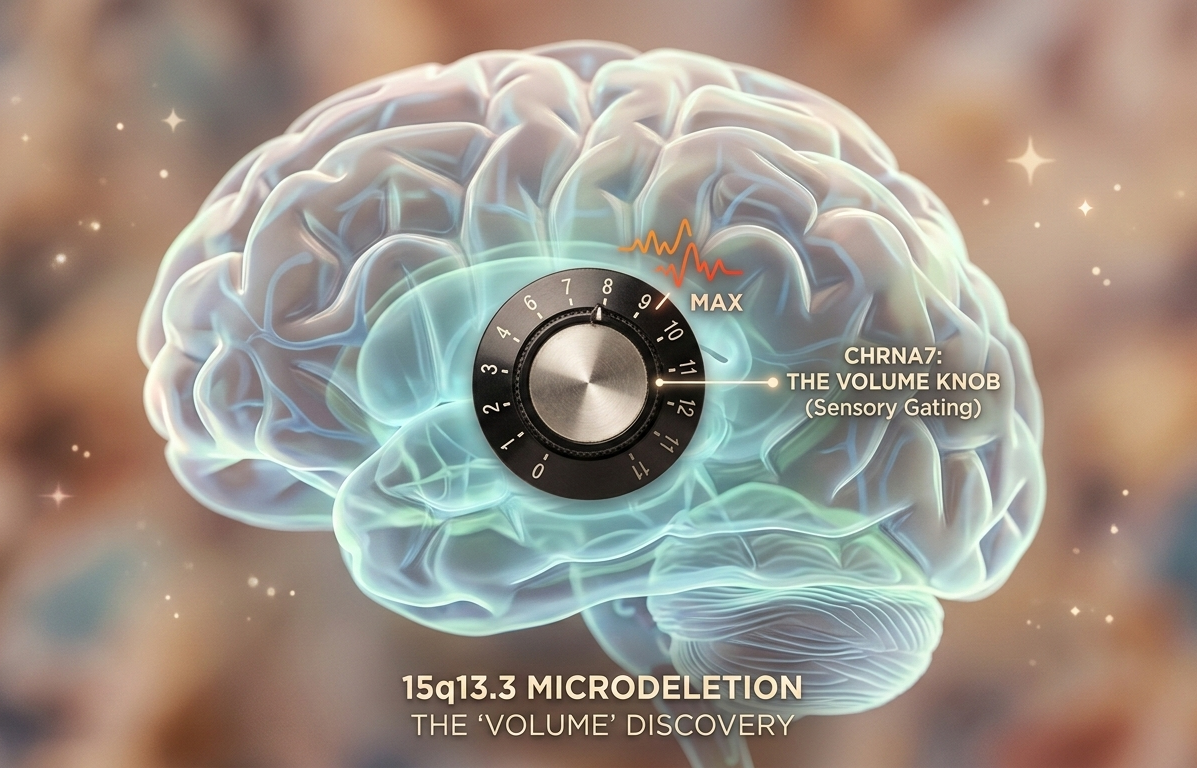
As a person with Chromosome 15q13.3 Microdeletion Syndrome, I have always struggled to explain those little things that come so easily to everyone else, but not for me. One of those is filtering out background noises as well as telling which direction a noise is coming from. I always suspected it was related to autism and ADHD. Thanks to a groundbreaking study, we now know that one of my deleted genes is responsible for me not having an “internal volume control.” Keep reading and let me explain why this is the best news I’ve heard all year!
Disclaimer: I may earn a commission from links or ads on GG.
Groundbreaking Scientific Announcement
On March 5, 2026, researchers analyzing the human 15q13.3 locus made a groundbreaking announcement. In their study, they finally get a glimpse into why people have these deletions so often. In particular, in this specific spot on the chromosome. What they have discovered is that the 15q13.3 area is basically a reshuffling hotspot. What can make the deletions more likely is if one parent has structural “inversions”. Think of it like a book being printed upside down. However, this does not mean anyone is broken. The genes just get reshuffled, like a deck of cards. All the cards are there, just in a different order.
Rare Disease Day: More Than You Can Imagine
In an interesting timing, the discovery was announced shortly after Rare Disease Day in 2026. That was on February 28, just a week before the announcement.
As for the motto, “More Than You Can Imagine,” it really does characterize what we go through as people with this condition as as parents of special needs kids. The disabilities and challenges really are more than you can imagine. It’s not easy to explain my condition to people, especially little things that can’t easy be explained. Such as having a normal IQ but with a slow processing speed. Or why I need breaks once an hour. Or why I can’t hear what you are saying over the barking dog down the street or the box fan on.
I was so excited when I read this discovery and I will explain why.
The Genes Involved
There are tons of genes involved, but I have two specific missing pieces: CHRNA7 and OTUD7A. As they do more research, they are figuring out what these genes control, and what can happen if they are missing.
The Volume Knob
In CHRNA7, one of its jobs is to be the internal volume knob that allows people to let background noise fade and only hone in on the person talking. For years, I went to doctor after doctor knowing something was wrong, but being unable to explain it. After a series of job firings, I went to a hearing doctor begging for help. He said my hearing was fine and I simply needed to “try harder.” Then, he walked out the door and I was left with no answers once again.
That was back in my early 20s and I’m approaching 49 now. Well, I guess the audiologist was right, and it wasn’t my hearing. I couldn’t figure out background noises like other people because I was literally MISSING THE PART TO DO SO! I can’t tell you how validating and wonderful it feels to have science back that up. Next time I struggle to hear someone over background noises, and they tell me I’m just being lazy, I can show them the scientific proof. And that, my sparkly friends, makes me feel so good!
Additional Source:
Study: Sensory Gating Analysis in Individuals with Copy Number Variants of CHRNA7. (National Institutes of Health / PMC)
Check out this sparkly blog post!